What Is A Typical Breakfast In Milan?
The Milanese breakfast is a coffee and a brioche taken standing at the bar, in minutes. Here is how it works, what it costs to sit down, and where to eat before 8 AM in Milan.
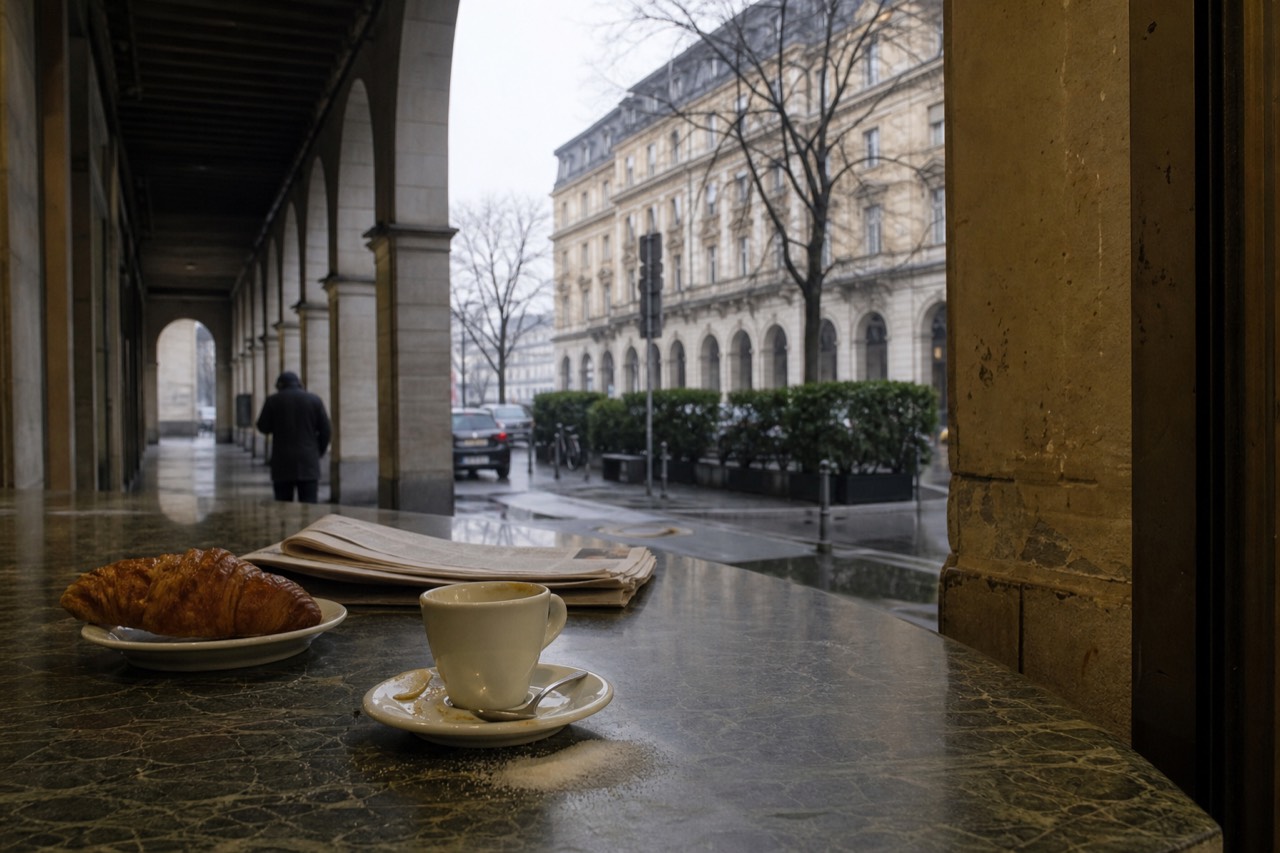
What Is A Typical Breakfast In Milan?
A typical breakfast in Milan is a coffee, usually an espresso or a cappuccino, plus one sweet pastry, most often a cornetto, eaten standing at the bar counter in a few minutes before work. It is not a seated meal, it rarely involves eggs or savoury food, and the whole ritual is built around speed and low cost.
That is the honest headline, and it surprises visitors more than any cathedral fact. The Milanese breakfast is a vertical affair. You walk into a bar, address the barista, drink your coffee where you stand, eat your pastry off a small plate or a napkin, pay at the register, and leave. Nobody lingers. Nobody orders a flat white with oat milk and a side of avocado, at least not in the bars Milanese people actually use at 7:30 AM.
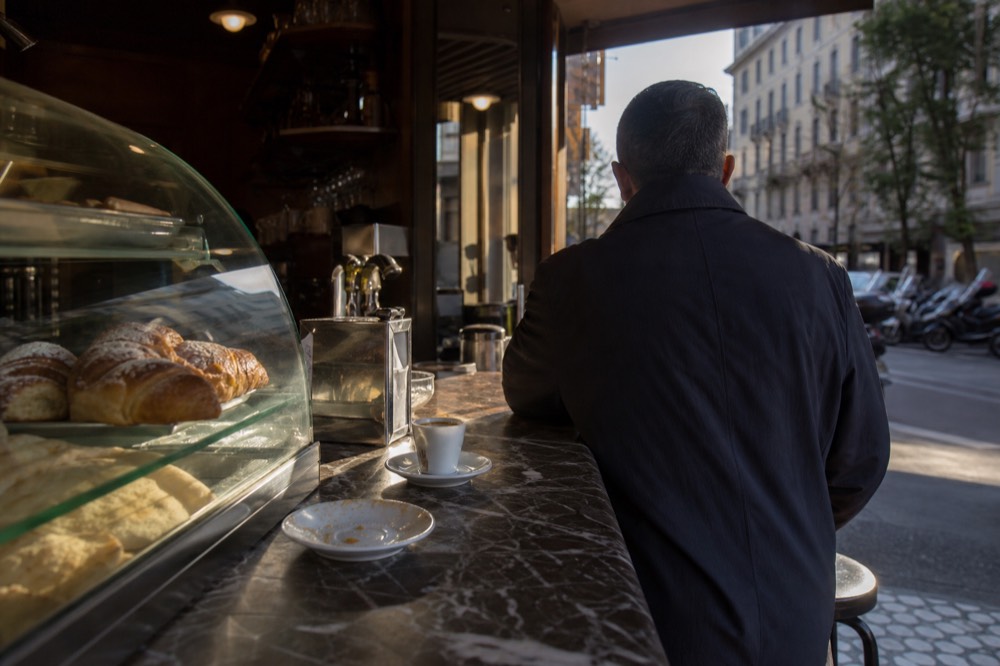
The pastry itself goes by two names, and this is worth settling early. In Milan and across most of Lombardy the word is brioche. In Rome and much of the south the same object is a cornetto. The product is similar to a French croissant but typically sweeter, softer, and less buttery: plain (vuota), with apricot or cherry jam (con la marmellata), with pastry cream (con la crema), or with chocolate (con il cioccolato). Order a brioche in a Milanese bar and you will get exactly what a local gets.
The drink rules are stricter than the pastry rules, and they are social rather than legal. A cappuccino before roughly 11 AM is normal. A cappuccino after lunch marks you as a foreigner, not because anyone will say anything, but because milk-heavy coffee is understood as a morning thing that sits badly on a full stomach. An espresso, called simply un caffè, is acceptable at any hour. If you want the full mechanics of Italian coffee ordering, the cappuccino clock and the rest, read our separate piece on the Italian coffee rule; this page stays on breakfast.
There is also a historical thread here that most visitors never hear. Milan's bar culture is inseparable from its aperitivo culture, and both grew out of the same Galleria. Gaspare Campari opened Caffè Campari on the corner of the Galleria Vittorio Emanuele II and Piazza Duomo in 1867, and his son Davide opened Camparino in Galleria in 1915 with a system piping soda water up from the cellars, according to the venue's own history page. The grand bar at the heart of Milan is a century old, and the fast, standing, counter-first habit it embodies is the direct ancestor of the three-minute breakfast.
If you would rather taste your way through Milan's pastry counters with a guide than decode them alone, these food walks are a good fit for a first visit.
Why Do Milanese Drink Their Coffee Standing At The Bar?
Standing at the bar is cheaper, faster and culturally default: bars in Italy charge one price for consumption at the counter and a higher price for table service, so the standing breakfast is the budget and time-efficient version, while sitting down can multiply the bill for the identical coffee and pastry.
This is the single mechanic that most changes a visitor's experience, so it deserves a proper explanation rather than a passing clause. An Italian bar runs two price lists in one room. The banco (counter) price applies when you order at the bar, drink standing, and pay at the register, usually first at the register in the morning rush, then present the receipt at the counter. The tavolo (table) price applies when a waiter serves you at a table, and it covers the service, the tableware, the outdoor seating, and the real estate. The same espresso and brioche can cost noticeably more seated than standing, and the gap widens sharply in tourist zones and on prime terraces, especially in the streets around the Duomo.
The practical takeaway is simple: if you want to eat breakfast the way Milan does, and pay what Milan pays, stand at the bar. If you want to sit for half an hour with a newspaper, sit, but look at the menu and its cover charge before you do, because you are buying the chair as much as the coffee. The seated surcharge is legal, standard and printed on the menu; it is not a tourist scam. It is the same logic as the coperto at dinner, a per-person cover charge that Italian restaurants may lawfully apply as long as it is clearly listed.
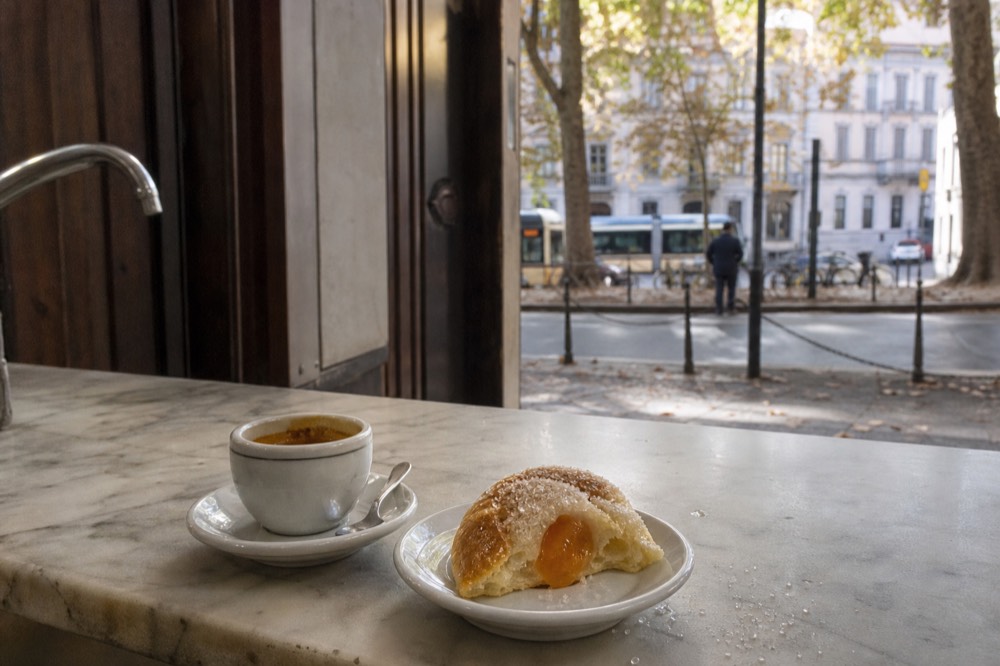
Speed is the other half of the answer. The standing breakfast exists because the working day in Milan starts early and the commute is real. A bar near a metro entrance in the morning is a machine: a dozen people at the counter, a barista calling out orders, receipts changing hands, and a steady rotation of customers who are in and out in the time it takes to drink a double shot. Do not mistake the speed for rudeness. Nobody is rushing you; you simply join the rhythm and leave when you are done.
One more habit worth copying: pay first, then order, in many bars. In the morning rush you take your receipt from the cassa to the barista, or you order, then pay, then show the receipt. Every bar has its own flow and the regulars know it. Watch one person before you commit, and you will look like you have done it for years.
Where Can You Eat Early In The Morning In Milan?
Milan's reliable early-morning food venues are its bars, which open from around 6 AM or earlier, and Mercato Centrale at Milano Centrale station, which opens at 6:30 AM every day of the week; most sit-down restaurants and delis open much later, with Eataly Smeraldo at 8:00 AM and Peck at 9:00 AM Tuesday to Saturday.
Early risers have fewer options than they might expect, but the options that exist are solid. The bar network is the backbone: any decent neighbourhood bar is serving coffee and brioche well before 7 AM, and in a city of commuters the supply follows the demand. Near stations and metro interchanges you will find bars opening at 6 AM or earlier.
| Venue | Address | Opens | Notes |
|---|---|---|---|
| Neighbourhood bars | Everywhere; densest near metro stops | Around 6 AM or earlier | Coffee and brioche at counter prices |
| Mercato Centrale Milano | Via Sammartini, corner of Piazza Quattro Novembre | 6:30 AM daily | Food hall inside Centrale station, 27 vendor stalls |
| Eataly Milano Smeraldo | Piazza XXV Aprile 10 | 8:00 AM daily | Sits on the M2/M5 Moscova side of Porta Nuova |
| Peck delicatessen | Via Spadari 9 | 9:00 AM Tue-Sat | Closed Sunday; Monday only 15:00-19:30 |
Mercato Centrale deserves its own paragraph because it solves the earliest problem in the city. The venue's own information page publishes hours of 6:30 to 23:00 every day, at Via Sammartini on the Piazza Quattro Novembre side of Milano Centrale station, reachable on metro lines M2 and M3. You order directly from the vendor stalls, sit where you like, and order drinks at the table; no booking is needed. For a traveller with a morning train, or anyone landing at Linate at dawn, it is the one place where a proper sit-down breakfast exists before most bars have wiped down their second counter.
The Peck row in the table carries a warning worth its own sentence: the city's most famous delicatessen, at Via Spadari 9 since 1912, opens at 9:00 AM Tuesday through Saturday, is closed on Sunday, and on Monday opens only in the afternoon at 15:00, per the shop's own published hours. A Monday-morning food walk past Peck will find the shutters down. Plan around it, or save Peck for a lunch of cheeses and cured meats instead.
If you want a guided early walk through the city's food institutions rather than a self-guided one, the street food walk by Pink Umbrella Tours starts in front of the Church of San Maurizio and runs 2.5 hours from $57 per person, rated 4.7 across 934 reviews, with free cancellation up to 24 hours.
What Sweet Things Count As Breakfast In Milan?
Breakfast in Milan is sweet, not savoury: the core products are the brioche or cornetto in its plain, jam, cream and chocolate variants, plus coffee-based drinks, while richer items like panettone are seasonal Christmas products defined by a national decree, and even bread-type specialties like Pan de Mej have their own municipal designation tied to a fixed date.
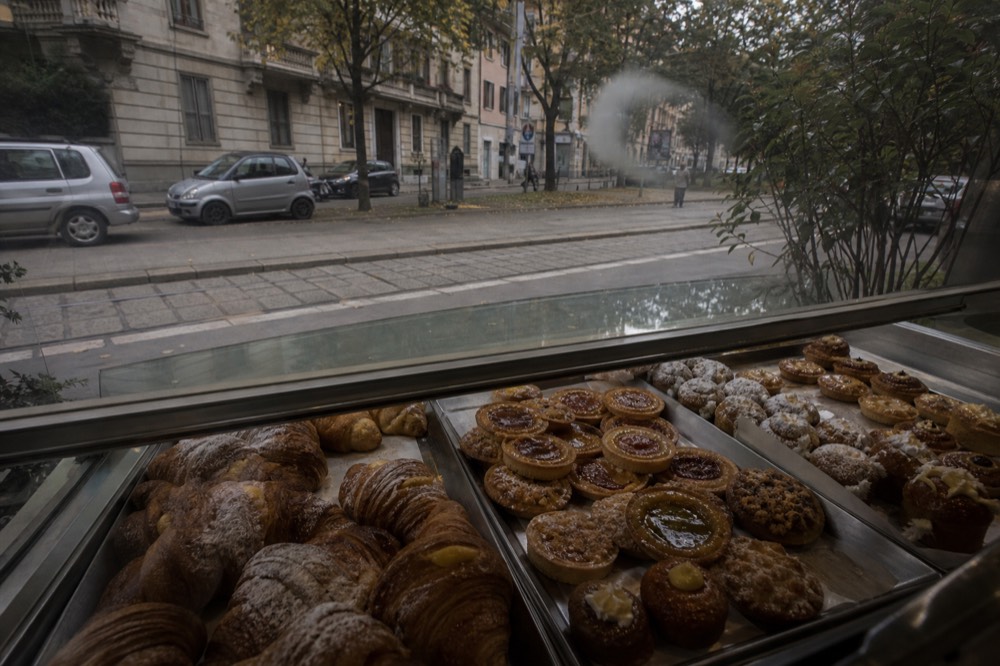
The sweet counter is where breakfast and patisserie overlap, and Milan takes its pastry seriously. Beyond the brioche family you will find kranz, ciambelle, brioche salate for the savoury-inclined, and in the best pasticcerie a full vitrina of cream-filled seasonal items. What you will not find, in an authentic bar at breakfast, is eggs, bacon, or toast. Savoury breakfast simply is not part of the local tradition; asking for it in a traditional bar will produce a polite blank stare or, at best, a tramezzino sandwich.
Panettone is the interesting case, because it is legally more defined than almost any food on the breakfast counter, yet it belongs to December. A national sale-name decree, Decreto 22 luglio 2005, published in Gazzetta Ufficiale n. 177 of 1 August 2005, reserves the name panettone to a naturally leavened sourdough product containing at least 16 per cent butterfat, at least 4 per cent egg yolk, and at least 20 per cent raisins and candied citrus peel, as the official text sets out. A 2017 amendment updated the egg and butter categories. Milan's own recognition of panettone is municipal, the De.Co. register established by the Comune di Milano in 2007, not an EU designation; the distinction matters if you care about labels, and our panettone in Milan guide covers it in depth.
The De.Co. register, published on the Comune's own food policy pages, is also where the newest breakfast-relevant fact lives: Pan de Mej, a sweet cornmeal cake, was added to the register in 2026, tied to the feast of San Giorgio on 23 April. It is a once-a-year product, and almost no tourist coverage mentions it.
For visitors who want the pastry counter explained rather than merely sampled, the Patisserie Sweets Walk by Do Eat Better runs 2.5 hours from $65.07 per person, rated 4.8 across 59 reviews, starting at Largo Guido Donegani near the centre. The listing shows it is booked 46 days ahead on average, so it rewards early planning.
Is A Hotel Breakfast Buffet Worth It In Milan?
A hotel buffet in Milan typically costs between roughly 10 and 25 euro per person per day when not already bundled into the room rate, and it buys you the seated, international breakfast the city itself does not make: eggs, bacon, pastries and juice in a dining room, which is convenient for families and early sightseeing but is a different meal from the Milanese bar breakfast.
The honest framing is that these are two different products serving two different needs. The bar breakfast is fast, cheap and local. The hotel buffet is slow, priced accordingly, and international. If your day starts with a 8:15 timed entry at the Duomo terraces or a Last Supper slot, the buffet in the building you slept in has real value; if your day starts whenever you feel like it, walking out to the nearest bar with a good pastry counter costs a fraction of the price and is the experience you came for.
| Feature | Bar breakfast (standing) | Bar breakfast (seated) | Hotel buffet |
|---|---|---|---|
| Typical contents | Coffee or cappuccino, one brioche | Same, served at a table | Eggs, bacon, pastries, fruit, juice, coffee |
| Time required | 3-10 minutes | 20-40 minutes | 30-60 minutes |
| Price mechanic | Counter price, the lowest | Higher table-service price | Fixed daily rate, often 10-25 euro when not bundled |
| Local authenticity | The default Milanese breakfast | Halfway house | International hotel standard |
| Best for | Commuters, quick starts, budget | Slow mornings, groups | Families, early sightseeing schedules |
Treat the 10-25 euro band as a planning range, not a promise: rates vary by hotel class and season, and many Milan hotels bundle breakfast into the room rate, in which case the marginal cost of eating it is zero and the calculation changes completely. Check whether your rate includes it before you pay twice.
One budget note that belongs here rather than anywhere else: if you are counting the whole cost of a Milan morning, the city's tourist tax applies per person per night from 1 April 2026, from 3 euro at one-star hotels up to 12 euro at five-star properties, with short-term rentals and B&Bs at 9.50 euro. It does not touch breakfast, but it belongs in the same mental ledger.
The deeper answer to whether the buffet is worth it is cultural. Milan's own breakfast is one of the few daily rituals that has survived every wave of globalisation intact, from the 1915 opening of Camparino to the 9.6 million arrivals the city recorded in 2025. Skipping it in favour of hotel scrambled eggs is not wrong, it is just a missed encounter with the city at its most unguarded. For the rest of the eating day, our typical Italian lunch piece picks up where breakfast leaves off, and the team at Milan Food Tours covers the full arc from morning coffee to evening aperitivo.
If breakfast has made you hungry for the rest of Milan's food culture, these three walks cover the sweet, the savoury and the sit-down sides of the city.
The questions below are the ones travellers ask most about the Milanese morning: what counts as a typical breakfast, whether standing at the bar is really the norm, when cappuccino is acceptable, where to eat before 8 AM, whether an American breakfast exists, and how panettone fits in. Each answer is short, factual and drawn from the same reporting as the page above.
Common Questions About Breakfast In Milan
What Is A Typical Breakfast In Milan?
A coffee, usually an espresso or cappuccino, plus a sweet pastry, most often a brioche, eaten standing at the bar counter in a few minutes. It is sweet rather than savoury, fast rather than leisurely, and cheap at the counter. Eggs and bacon are a hotel-buffet product, not a Milanese one.
Do Milanese Really Eat Breakfast Standing Up?
Most do, most mornings. Standing at the bar is the cheapest and fastest way to take breakfast, and it is the cultural default before work. Sitting at a table is always available but costs more, because Italian bars charge a higher table-service price for the same coffee and pastry.
Is A Cappuccino At Breakfast Acceptable In Milan?
Yes, completely. A cappuccino or caffè latte with a brioche is the classic Milanese breakfast order. The milk-coffee restriction applies later in the day: ordering a cappuccino after a meal, especially after lunch or dinner, is the habit locals avoid.
Where Can I Get Breakfast Before 8 AM In Milan?
Neighbourhood bars open around 6 AM or earlier, especially near stations and metro stops, and Mercato Centrale at Milano Centrale station opens at 6:30 AM every day. Eataly Smeraldo opens at 8:00 AM, and Peck does not open until 9:00 AM Tuesday to Saturday, closing on Sunday and opening only in the afternoon on Monday.
Can I Get An American Breakfast In Milan?
Yes, in hotels and a handful of international cafes, typically as a paid buffet or brunch-style menu. It is not part of local tradition, it costs more than the bar breakfast, and it takes longer, so plan it deliberately rather than expecting it everywhere.
Is Panettone Eaten For Breakfast?
In Milan, mainly at Christmas, when panettone does appear on breakfast tables. It is a seasonal product defined by a national decree that sets minimum butter, yolk and candied-fruit content, and artisan versions in Milan were listed above 50 euro per kilo in the 2025 season. Outside December, the everyday breakfast pastry is the brioche.