Pizza In Milan: Styles, Pizzerias And What To Actually Order
Milan spent decades pretending to be a pizza city it is not, and then quietly built a pizza scene worth taking seriously on its own terms. Here is how to read it: three distinct styles, a wave of new openings, and one class where you make the pie yourself.
Short answer
Milan has three real pizza styles: the al trancio slab sold by weight, contemporary high-hydration round pizza, and Neapolitan imports. A pizza-making class runs from $65.28 per person at Mercato Centrale. New pizzerias opened across Tortona and Navigli through 2025 and 2026, while the century-old Da Giulio closed in May 2026.
Milan has more than 9.6 million tourist arrivals a year and, by the city's own count, a food scene that has stopped trying to imitate Naples. The interesting result is a pizza landscape with three genuinely different styles in it, a run of new openings through 2025 and 2026, and one 101-year-old pizzeria that closed in May 2026. Any list claiming to rank the "best pizza restaurants in Milan" would be invented, because no such ranking exists in any verifiable source. What does exist is a clear set of styles, a documented set of openings and closures, and a handful of tours and classes that put a pizza in your hands. This guide sorts by style and by what each one suits.
Is Milan A Pizza City?
No, Milan is not a pizza city in the way Naples is, and it has stopped pretending to be. Milan's own tradition is the al trancio slab, its recent strength is contemporary high-hydration dough, and its Neapolitan pizzerias are imports from the south rather than a native tradition. That mix, not a single canon, is what makes pizza here worth a guide.
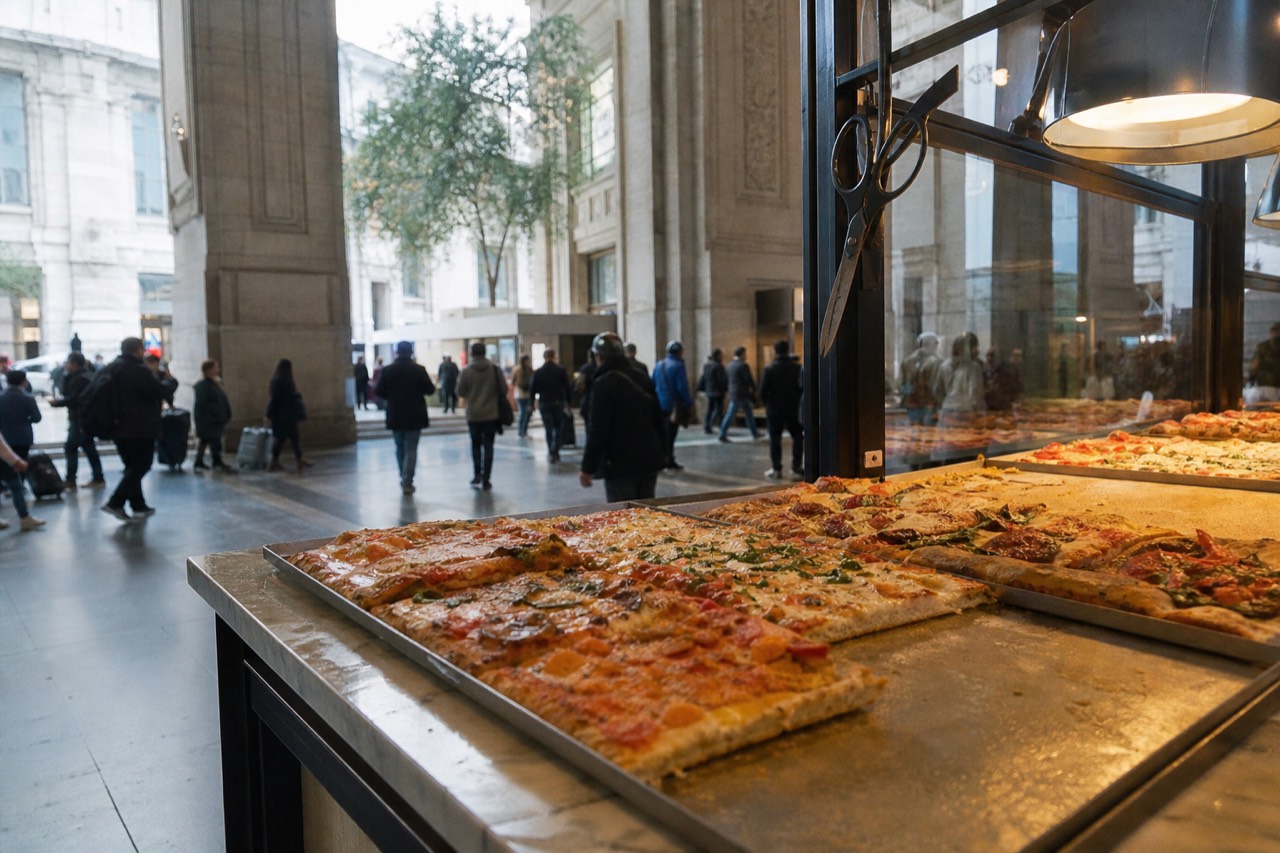
The honest framing matters. Naples has a codified pizza tradition with rules, history and a protected name. Milan's native entry, pizza al trancio, is a thick, rectangular slab baked in a tray, cut with scissors and sold by weight, closer in spirit to focaccia than to a Neapolitan margherita. It grew out of post-war bakery counters, not out of a pizzaiolo guild.
Around that native slab, the last two decades have layered in two more styles. Contemporary Milanese pizzerias took the Neapolitan round shape but pushed hydration and fermentation in a lighter, crispier direction, and a wave of Neapolitan imports brought the soft-centred original north with them. A visitor who orders "pizza" three times in Milan can easily eat three different products, at three different prices, in three different settings.
That is why this guide refuses to rank. Instead it separates the styles, tells you where each is sold, lists the documented openings and closures from 2025 and 2026, and points to the one class where you make the pizza yourself. If you want the broader street-food context, our Milan street food guide covers the slice-and-walk options in more depth.
What Are The Three Pizza Styles In Milan?
Milan's three pizza styles are pizza al trancio, the thick rectangular slab sold by weight at bakery counters; contemporary Milanese round pizza, a high-hydration, long-fermented dough baked crisp; and Neapolitan pizza, the soft-centred round imported from Campania. Each has its own dough, format, price band and natural habitat, and mixing them up is the main way visitors end up disappointed.
The table below is the core of the whole guide. Read the "where it is sold" column before you order, because the setting is part of the product.
| Style | Dough and format | Typical setting | Price logic | What it suits |
|---|---|---|---|---|
| Pizza al trancio | Thick, rectangular, tray-baked, cut to order | Bakery and deli counters, often eaten standing or takeaway | Sold by weight, so you pay for exactly what you point at | A fast, cheap, filling lunch; kids; walking |
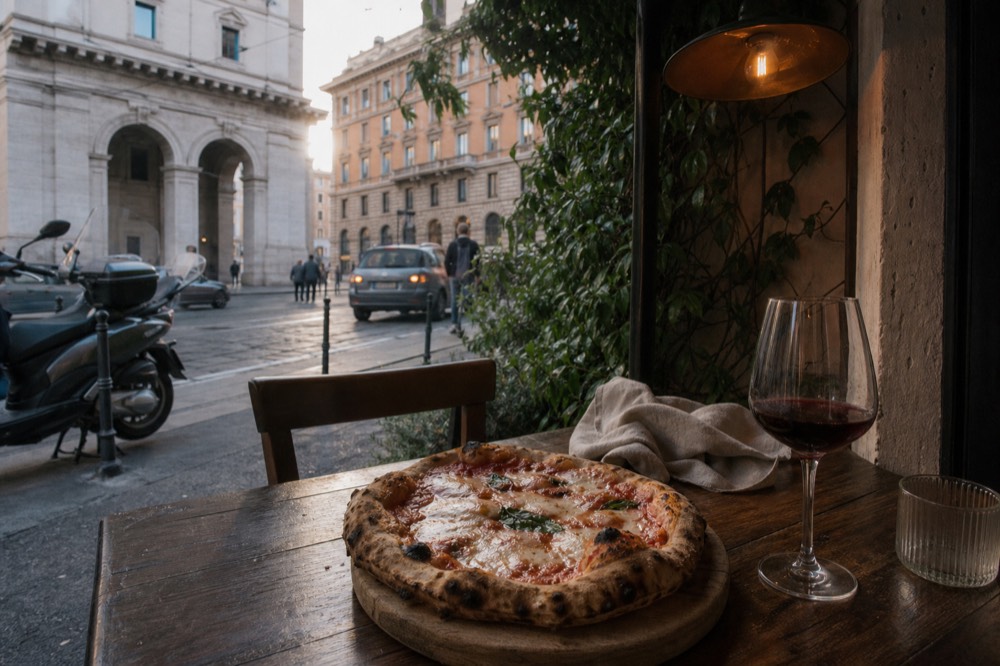
| Contemporary Milanese round | High hydration, long fermentation, airy rim, crisp base | Sit-down pizzerias, often with natural wine lists | Whole-pie pricing, mid band, per pizza | A relaxed dinner, a date, wine pairing |
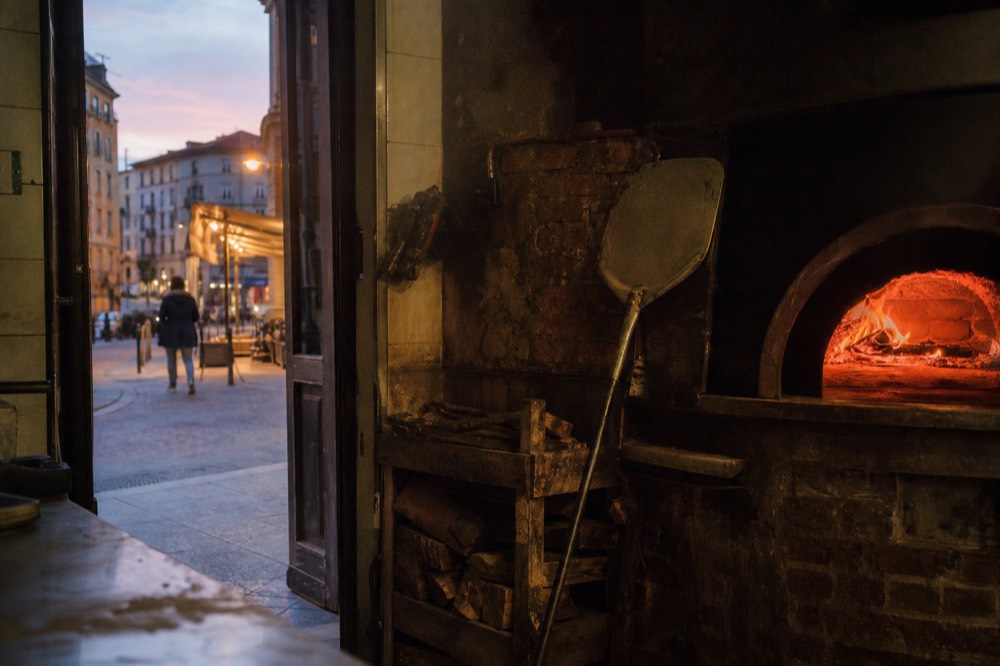
| Neapolitan import | Soft, wet-centred round, 60-90 second bake | Dedicated Neapolitan pizzerias, wood-fired oven in view | Whole-pie pricing, mid band | The classic margherita experience, purists |
Two practical notes. First, al trancio pricing by weight means the same slice can cost very different amounts depending on where in the tray it comes from; the corner pieces, with more crust, weigh differently than the middle. Point, let the counter hand weigh it, and the price follows. Second, the contemporary Milanese style is the one that has changed fastest, and it is where nearly all the 2025-2026 openings cluster, which is the next section's subject.
If you would rather taste your way across these styles with a guide than decode them alone, these three walks and classes are the ones that fit a pizza-focused day:
Which Style Of Pizza Should You Choose?
Choose al trancio for a fast, cheap lunch eaten on the move; choose contemporary Milanese round pizza for a sit-down dinner with wine; choose a Neapolitan import when you want the classic soft-centred margherita. If you only have one pizza meal in Milan, the contemporary style is the one you cannot get in the same form elsewhere.
The reasoning is about scarcity. Neapolitan pizza you can eat in Naples, and in a hundred cities that import it. Al trancio is genuinely Milanese but it is a workaday product, excellent fresh from the oven and unremarkable reheated hours later. The contemporary high-hydration round, fermented for a day or more and paired with a serious wine list, is the style that Milan's own pizzeria scene has made distinct, and it is the style the new openings below are actually cooking.
There is also a timing angle. Al trancio counters are at their best around midday, when the trays come out of the oven fresh. Sit-down pizzerias in Milan open for dinner service, typically from around 19:00, and Milanese diners eat late; our piece on dinner times in Milan covers the rhythm. Arriving at 19:00 sharp often means an empty room and the first bake of the evening, which is not a bad thing.
One more filter worth applying: how much of your Milan food budget pizza deserves to take. A slice-and-walk day built on al trancio and street counters costs a fraction of a sit-down dinner, and the money saved goes further in Milan's gelato and pastry shops, which are covered in our best gelato in Milan guide.
Which Pizzerias Opened And Closed In 2025 And 2026?
The documented 2025-2026 changes include Smash House opening its third location at Via Tortona 12 in December 2025, a boom of more than 112 new food enterprises on and around Via Paolo Sarpi since early 2024, and the closure of Antica Pizzeria Da Giulio on Corso San Gottardo in May 2026 after 101 years. The full verified list is below.
This is where most "best pizza in Milan" lists fall apart: they are static. Milan's pizzeria landscape moved measurably in the last two years, and the movements are on record. The openings below come from the city's food press; each entry carries its source.
| Pizzeria or area | What happened | When | Source |
|---|---|---|---|
| Smash House, Via Tortona 12 | Third location opened | December 2025 | MilanoToday |
| Via Paolo Sarpi and surroundings | 112+ new food enterprises registered since early 2024, many street food and slice formats | Ongoing through 2025 | Corriere della Sera |
| Mercato Centrale, Via Sammartini | Reopened progressively after a February 2026 hygiene suspension of 17 of 27 activities, with vendors including pizza and bakery counters returning | February 2026 onward | MilanoToday, Corriere della Sera |
| Antica Pizzeria Da Giulio, Corso San Gottardo | Closed after 101 years; the 1925 pizzeria was bought by an Asian restaurant group | May 2026 | Corriere della Sera |
The Da Giulio closure is the one that stung locally: a pizzeria that opened in 1925 in the Ticinese district, closing after more than a century, as Corriere della Sera reported. The Sarpi boom runs the other direction: the city registered well over a hundred new food businesses on and around Via Paolo Sarpi since early 2024, many of them slice and street formats, to the point that the Comune issued a cleanliness and decor ordinance for the street in June 2026, per the official ordinance. For a pizza visitor, Sarpi has quietly become one of the densest cheap-slice corridors in the city.
Where Is Each Style Actually Sold?
Al trancio is sold by weight at bakery and deli counters, concentrated around markets and commuter streets; contemporary round pizza is sold in sit-down pizzerias across Brera, Isola, Navigli and Tortona; Neapolitan pizza is sold in dedicated wood-fired pizzerias scattered through the same districts. The setting, not the name on the door, tells you which style you are getting.
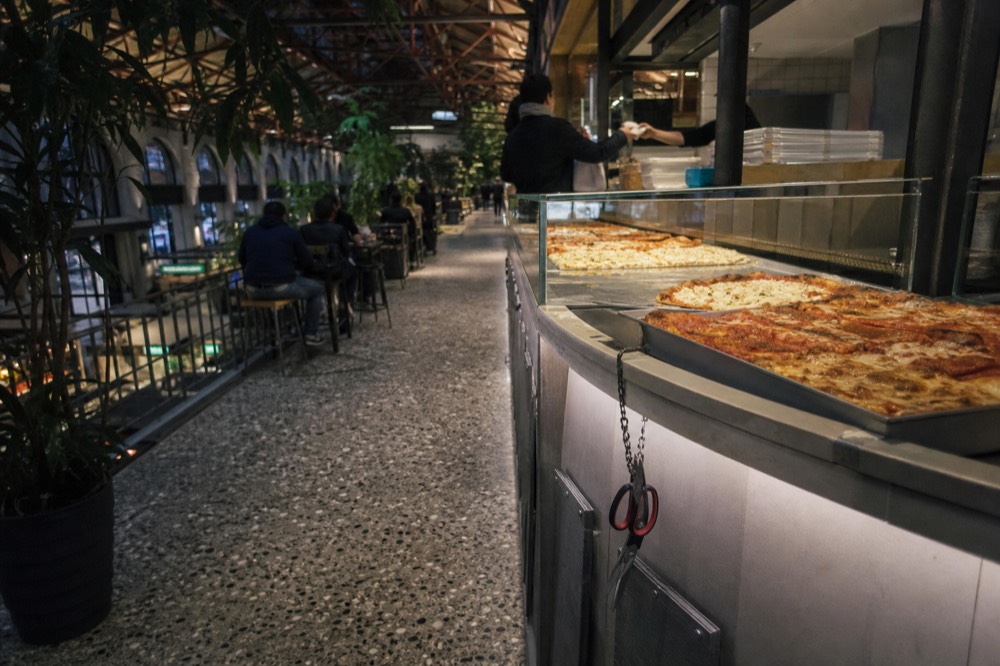
The fastest way to spot al trancio is the tray in a lit counter and the scissors hanging beside it. Markets are the natural home: the city's covered markets and food halls, covered in our Milan food markets guide, usually have at least one bakery slab counter, and Mercato Centrale at Milano Centrale station runs several pizza and bakery operations across its two floors after its 2026 reopening. The venue's own information page lists daily hours of 06:30 to 23:00, so a late-evening slice is realistic there.
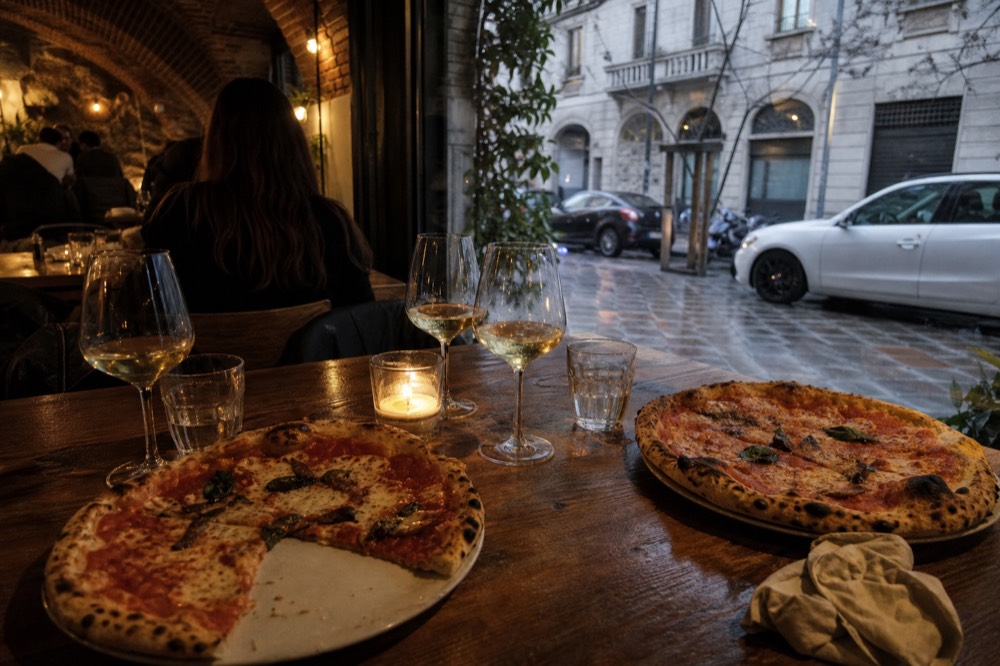
Contemporary round pizza lives in restaurants that look like wine bars as often as pizzerias. The districts to work are Brera and Isola for the older established names, Tortona and Porta Romana for the newest wave, and Navigli for the volume. The neighbourhood detail, including which districts are transforming fastest, is in our where to eat in Milan guide. For a wider view of how this site covers the city's food, Milan Food Tours publishes guides on everything from risotto to aperitivo hours.
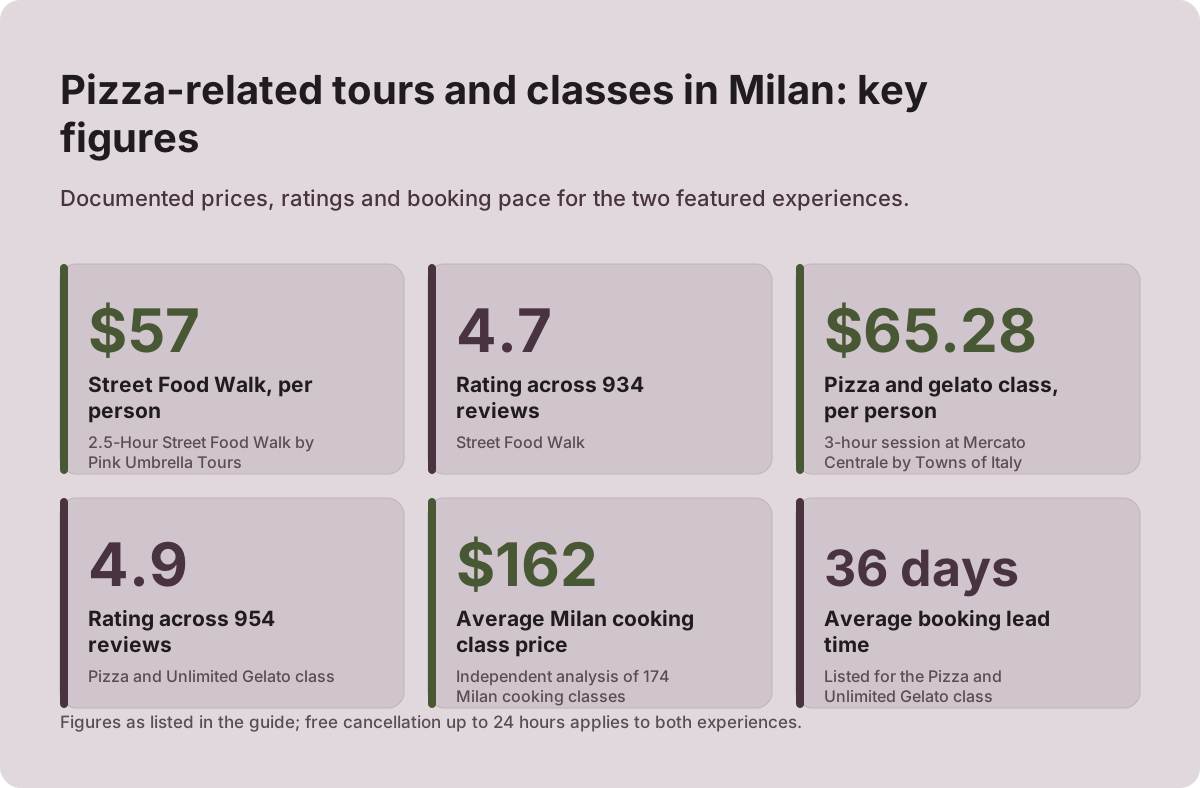
If tasting across counters with someone who knows them appeals, the 2.5-Hour Street Food Walk by Pink Umbrella Tours runs from $57 per person, is rated 4.7 across 934 reviews, and meets in front of the Church of San Maurizio by the stairs. It covers the counter-and-slice world that al trancio belongs to, with free cancellation up to 24 hours.
Can You Make The Pizza Yourself?
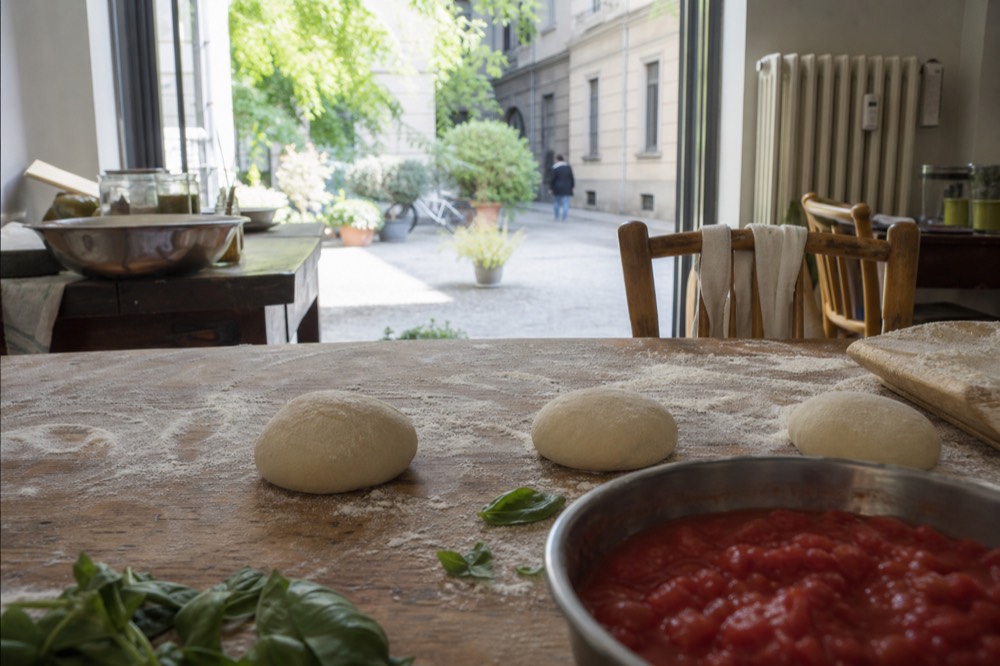
Yes, and in Milan the class to take is the 3-hour Pizza and Unlimited Gelato session at Mercato Centrale by Towns of Italy, from $65.28 per person, rated 4.9 across 954 reviews, with the meal and a wine tasting included. It runs at the cooking school on the first floor of Mercato Centrale, Via Giovanni Battista Sammartini 1, and the listing shows it is booked 36 days ahead on average.
The class is the featured pick here for a simple reason: it is the one product on the roster where pizza is the point rather than a stop. You get a hands-on dough session, you eat what you bake, and the gelato option is unlimited, which is a rare word on any Milan menu. The alternative format on the same listing swaps in pasta and tiramisu instead of pizza, so a group can split across both.
For context on price, an independent analysis of 174 Milan cooking classes puts the average at $162 for a typical 3-hour session, which makes the $65.28 from-price on this class notably low for the format. The wider class landscape, including pasta-focused options, is covered in our cooking classes in Milan guide. Free cancellation up to 24 hours applies, so it can be booked early without locking your itinerary.
How Much Does Pizza Cost In Milan?
A slice of al trancio at a counter typically costs a few euro by weight, a whole contemporary or Neapolitan round pizza in a sit-down pizzeria runs mid-band pricing per pie, and a pizza-making class starts at $65.28 per person including the meal and wine. Milan's spritz prices, for the drink beside the pie, run from EUR 3.50 in outlying bars to EUR 21 on the Duomo terraces.
The drink comparison is the useful one, because it is fully sourced. Corriere della Sera's pricing reporting put a spritz at EUR 4 with a mini buffet at Rondo in the Nolo area and EUR 3.50 at Picchio, against EUR 8 at Base in Tortona, EUR 9 at Montalcino Caffe on the Naviglio Grande and EUR 21 at Terrazza Aperol by the Duomo. The same spread logic applies to pizza: the same dough costs more on a designer street than it does two metro stops out.
| Product | Format | Price basis | Notes |
|---|---|---|---|
| Al trancio slice | Cut to order at a counter | By weight | Cheapest real meal in the city |
| Contemporary round pizza | Whole pie, sit-down | Per pizza | Mid band; wine lists push the bill up |
| Neapolitan round pizza | Whole pie, sit-down | Per pizza | Mid band, comparable to contemporary |
| Pizza and gelato class | 3-hour hands-on session | From $65.28 per person | Meal and wine tasting included |
| Street food walk with tastings | 2.5-hour guided walk | From $57 per person | Counter-style tastings |
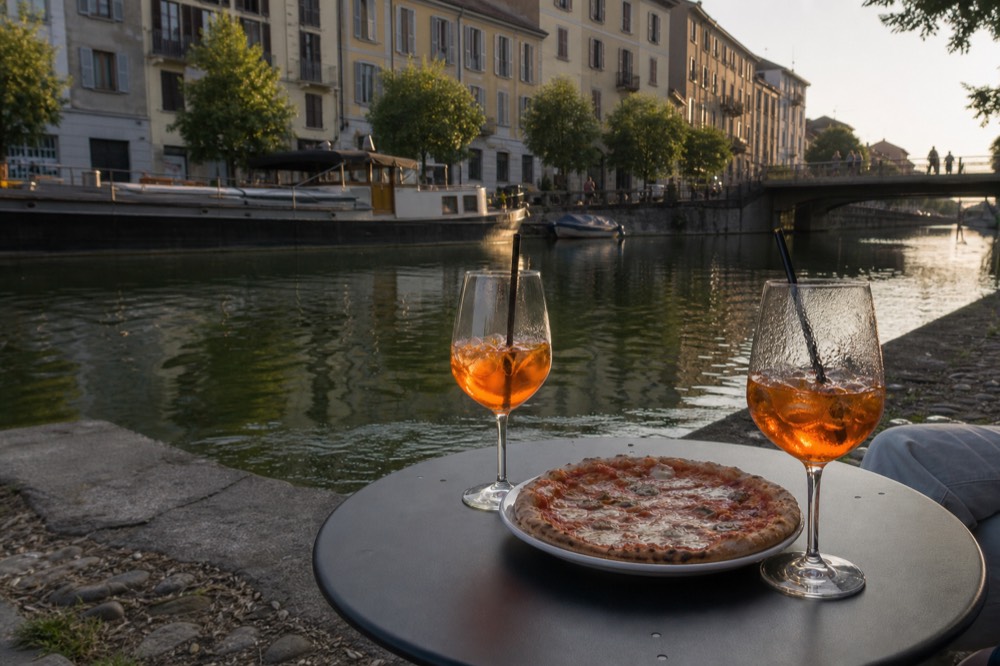
One planning note for evening pizza: the city's movida ordinance, in force from 11 June to 2 November 2026, restricts takeaway alcohol sales from midnight and outdoor table use from 01:00 on weekdays and 02:00 at weekends across 12 zones including Navigli, Brera and Ticinese, per the Comune di Milano announcement. A late pizza in Navigli ends earlier than it used to, and the ordinance is why.
For a fuller picture of eating-out costs across the city, our piece on whether eating out in Milan is expensive breaks down the whole budget.
How Do You Build A Pizza Day Around A Tour?
A realistic pizza day pairs one counter slice at lunch, one guided walk or class in the afternoon, and one sit-down pie at dinner, using the metro's EUR 2.20 single ticket or the EUR 7.60 day ticket to move between districts. The 2.5-hour street food walk and the 2.5-hour city-highlights food walk both slot into the afternoon gap between them.
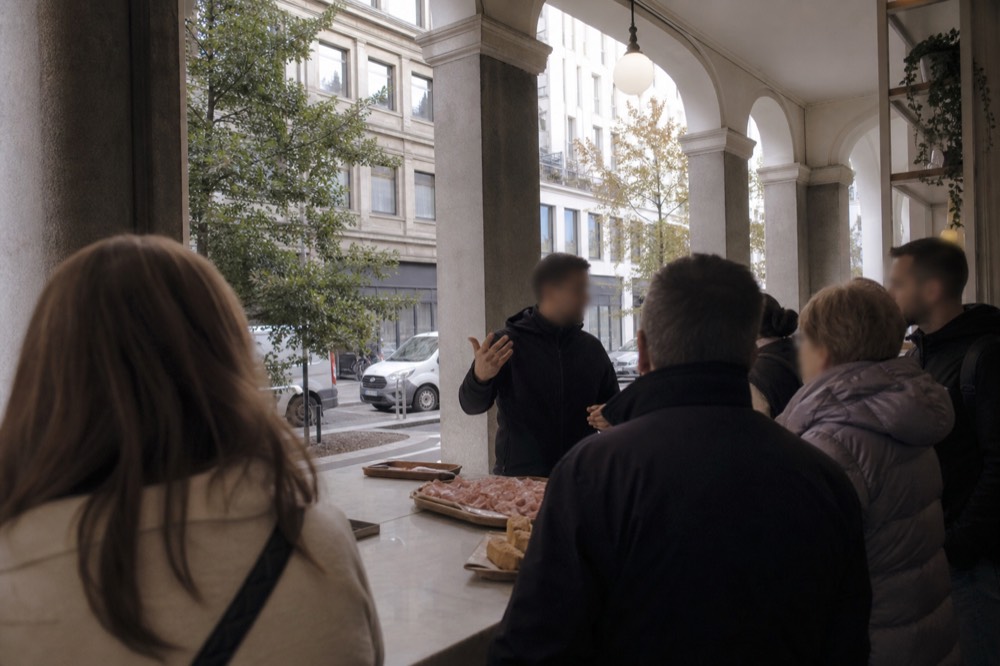
The two walks serve different purposes. The Pink Umbrella street food walk, from $57, is counter-focused and tasting-driven. The Food Walk With City Sightseeing by Tours of Milan, from $49.69 per person and rated 4.6 across 26 reviews, folds the tastings into a sightseeing loop that starts at Chiesa di San Maurizio al Monastero Maggiore on Corso Magenta, so it doubles as an orientation for a first visit. The listing shows five or more bookings in the past week.
The transport arithmetic comes from ATM's own tariff document: a single ticket is EUR 2.20 valid 90 minutes, a 24-hour ticket is EUR 7.60, and children under 14 travel free. Since a pizza day naturally spans three or four districts, from a market counter at noon to Navigli at night, the day ticket usually wins. Contactless cards work directly at metro gates and on trams, so there is no ticket queue to plan around.
If the day is tight, drop the dinner pie and let the class be the pizza: the Towns of Italy session ends with you eating your own bake, with wine, inside Mercato Centrale, which is open until 23:00 daily if anything else is wanted after.
The questions visitors ask most about pizza in Milan are whether the city has its own style, what happened to its oldest pizzerias, where the new openings are, what a slice or a class costs, and whether you can make a pizza yourself. The answers below draw on the verified openings, closures and pricing covered in the sections above.
Common Questions About Pizza In Milan
Is Milan Known For Pizza?
Not in the way Naples is. Milan's native pizza tradition is pizza al trancio, the thick rectangular slab sold by weight at counters, while its sit-down pizzerias cook either contemporary high-hydration round pizza or Neapolitan imports. The city's pizza identity is the mix of three styles, not one canon.
What Is Pizza Al Trancio?
It is a thick, rectangular pizza baked in a tray, cut with scissors to the size you point at, and sold by weight. It is Milan's own format, born in bakery counters, and it is usually the cheapest real meal in the city.
Which Pizzerias Closed In Milan Recently?
Antica Pizzeria Da Giulio on Corso San Gottardo closed in May 2026 after 101 years, reported by Corriere della Sera. Mercato Centrale also temporarily suspended 17 of its 27 activities in February 2026 for cleaning before reopening progressively.
Where Are The New Pizza Places In Milan?
The documented 2025-2026 openings cluster in Tortona, where Smash House opened its third location in December 2025, and around Via Paolo Sarpi, where more than 112 new food enterprises have registered since early 2024, many in slice and street formats.
Can You Take A Pizza-Making Class In Milan?
Yes. The Towns of Italy class at Mercato Centrale runs 3 hours from $65.28 per person, rated 4.9 across 954 reviews, covering pizza with unlimited gelato or pasta with tiramisu, with the meal and a wine tasting included. Free cancellation applies up to 24 hours before.
How Much Does Pizza Cost In Milan?
A counter slice of al trancio costs a few euro by weight, whole pizzas in sit-down pizzerias run mid-band per pie, and the pizza class starts at $65.28 per person. A spritz beside the pie runs anywhere from EUR 3.50 in outlying bars to EUR 21 on the Duomo terraces.
Before you go, these three are the picks that fit a pizza-focused visit best: